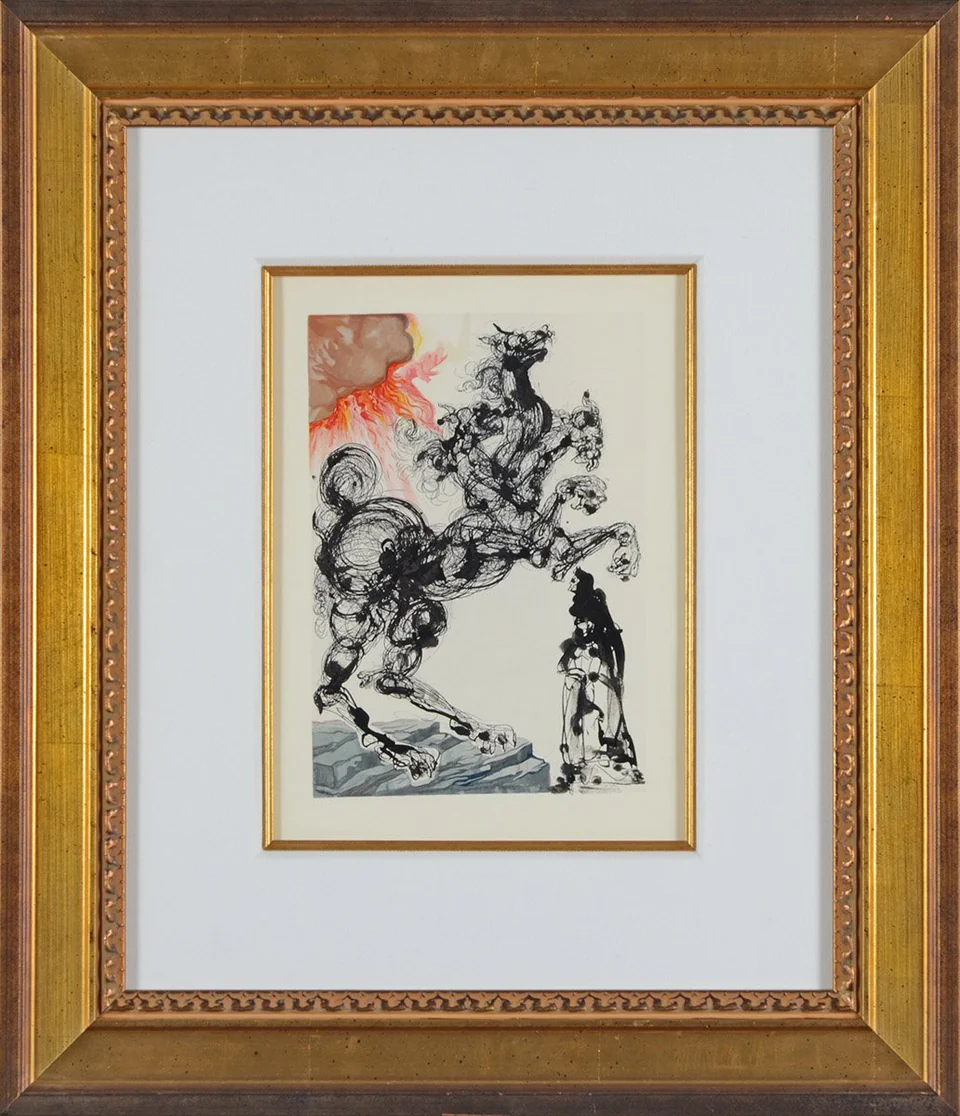
Description of Art: Hell Canto 6 unfolds in an atmosphere of cold turbulence and relentless hunger, and Dalí transforms this canto’s descent into the realm of the gluttonous into a scene saturated with bleak motion and oppressive dampness. The palette churns with murky greens, heavy browns, and dim slate-blues—colors that drift like sodden mist over a ground soaked in perpetual filth. The light is dull and suffocating, revealing forms with a wet heaviness that echoes the canto’s sense of excess turned to decay.
At the center, elongated figures writhe and huddle in contorted poses, their bodies pressed into the earth as though burdened by the weight of their own indulgence. Dalí traces their forms with crisp engraving lines before allowing their edges to dissolve into the surrounding muck-like haze, creating the impression of souls sinking into, and rising from, the very substance of their punishment. Their gestures—strained, slack, or reaching weakly upward—capture the canticle’s grim vision of appetite collapsed into helplessness.
Dante stands slightly apart, his figure rendered with steady, cleaner contours that anchor him within the blurred, oppressive landscape. His posture leans forward with wary compassion, his gaze fixed upon the suffering shapes before him. Dalí gives him a quiet gravity, intensifying the contrast between the living traveler’s clarity and the suffocated motion of the damned.
Nearby, a looming form—suggestive of the monstrous guardian—rises in a hunched, bestial posture. Dalí shapes this figure with a blend of sharp definition and dissolving shadow, giving it an unsettling presence that seems both imminent and receding. Its posture conveys a watchful, predatory patience, heightening the canto’s atmosphere of dread and inevitability.
The surrounding landscape is bleak and disordered: the ground ripples with slick, uneven texture; faint shadows drift like cold breath across the wasteland; and distant mounds melt into the dimness, forming a horizon as heavy and airless as the realm it encloses. The scene feels claustrophobic, shaped entirely by the weight of unending storm and moral stagnation.
Dalí distills the essence of Canto 6 into a moment of sodden despair—a vision where desire collapses into degradation, where movement becomes a slow drowning in one’s own excess, and where the Inferno reveals the chilling aftermath of pleasure stripped of purpose. It is a scene shaped by damp shadow and muted suffering, capturing the bleak gravity at the core of this canto.