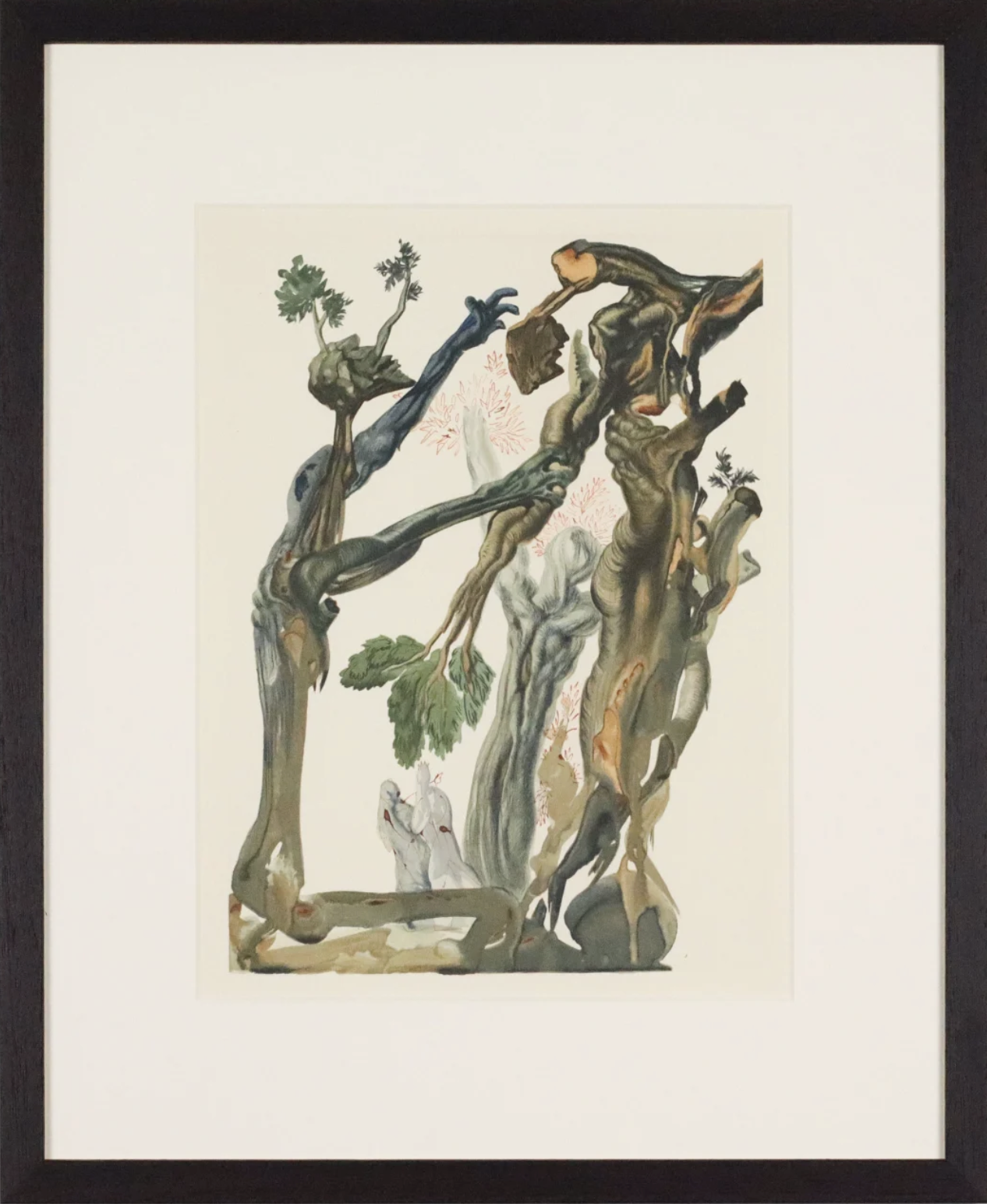
Description of Art: Hell Canto 13 unfolds in an atmosphere of haunted stillness and wounded transformation, and Dalí translates this canto’s vision of the suicides and the harpies into a scene marked by fragile darkness and aching symbolism. The palette is composed of ashen greens, muted browns, and pale grays—colors that drift like breath through a forest stripped of life. The light is thin and mournful, illuminating forms with a quiet sorrow that lingers in every contour.
At the center, an elongated tree-form bends in a posture that feels almost human, its branches twisted like limbs caught between motion and imprisonment. Dalí renders the trunk with delicate engraving lines before allowing sections to dissolve into shadowed haze, suggesting a soul whose identity has merged irrevocably with the barren wood. The contorted shape captures the canto’s essence: pain that has taken root, transformation born of despair, and the stillness that replaces a life once lived.
Nearby, a harpy descends—its form an unsettling blend of winged grace and predatory distortion. Dalí shapes the creature with both precision and drift, giving its wings a luminous blur while its grasping limbs emerge with sharper clarity. The harpy’s twisted poise hints at the torment it inflicts, a perpetual violation of the souls who can only speak when wounded.
Dante stands at the edge of the scene, delineated with steadier, more grounded contours. His posture leans forward in a gesture of deep, troubled attention; his gaze is fixed upon the tortured tree as though listening for the voice that emerges only under suffering. Dalí emphasizes his human vulnerability, making him a still point of empathy within a realm defined by anguish.
The landscape around them dissolves into a surreal, spectral forest: trunks rise in uneven clusters, branches curl like broken gestures, and the ground is soft with drifting shadow, as though saturated with sorrow. The horizon fades into dimness, devoid of sky or relief—an enclosed world shaped entirely by loss, silence, and slow, enduring pain.
Dalí distills the essence of Canto 13 into a moment of quiet devastation—a vision where identity becomes bark and branch, where pain speaks only through wounding, and where the Inferno reveals the tragic permanence of choices made in despair. It is a scene shaped by muted light and suspended sorrow, capturing the haunting fragility at the heart of this canto.