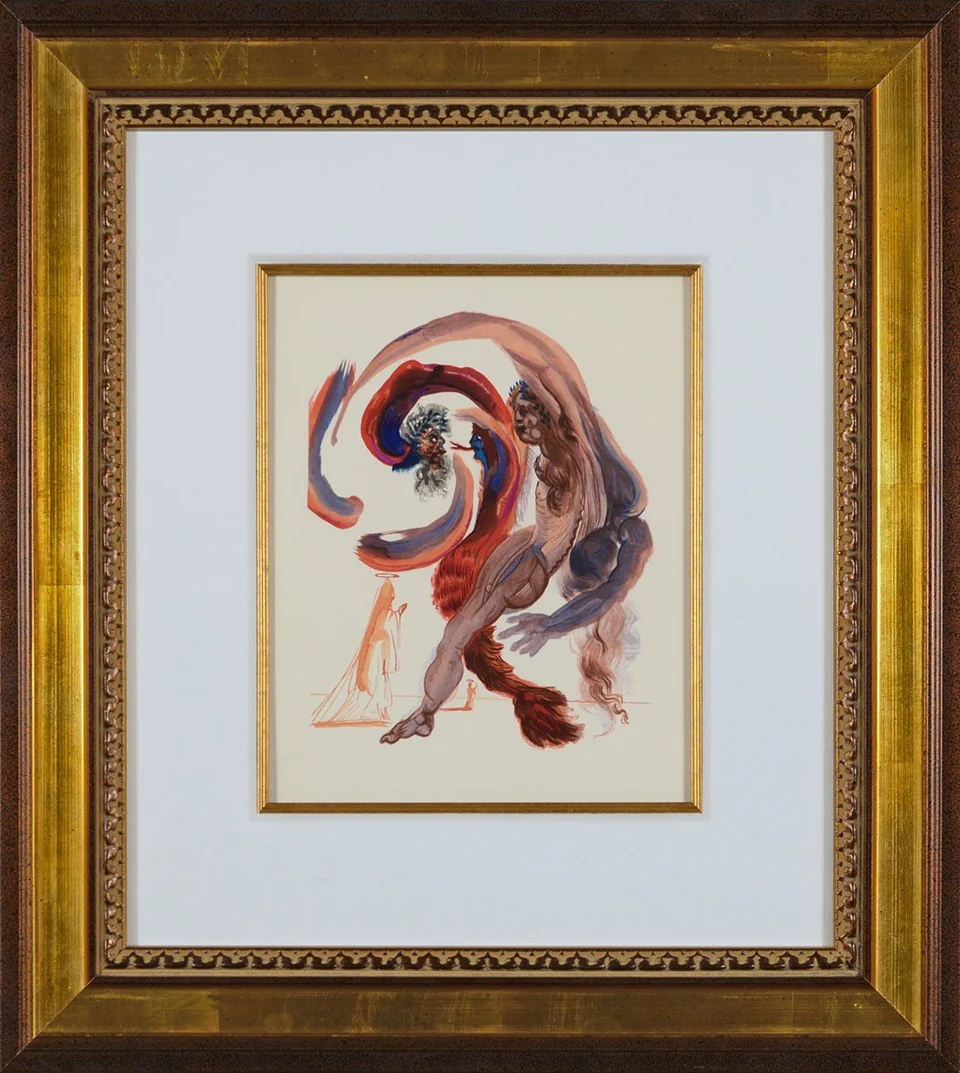
Description of Art: Purgatory Canto 18 by Salvador Dalí renders Dante’s passage into the Fourth Terrace—a realm where the slothful enact their quiet suffering—with a haunting stillness and surreal poetic precision. The palette glows with soft golds, pale green-blue hues, and fade-rose shadows, creating an enveloping atmosphere of suspended purification. Light seems to swell from within the composition, bathing figures and environment in an other-worldly glow.
At the core of the image, a procession of attenuated figures drifts across the terrain. Their elongated limbs and flattened silhouettes convey both physical weariness and spiritual lifting; they stride forward as if gravity itself loosens beneath them. Dalí outlines each with delicate engraving lines, then blurs their edges with washes of misty color—so that these souls appear simultaneously emerging into form and dissolving into light.
Dante’s figure stands slightly removed, humble and watchful. His silhouette remains more grounded than the others, his lines clear, his gaze upward. He is both observer and participant—caught in the threshold between human inertia and the motion of redemption. The environment around him shifts accordingly: rocks melt into shadowdrift, trees bend as though in prayer, and pathways curve toward a horizon that is both real and ethereal.
Dalí fills the scene with subtle tension: the inertia of sloth grappling with the pull of hope, the slow churning of souls moving toward truth. The result is not a moment of spectacle but one of quiet turning—a landscape and vision that invite the viewer into introspection. In this work, the boundaries between burden and release blur, and the soul’s journey upward becomes visible, delicate, and inevitable.