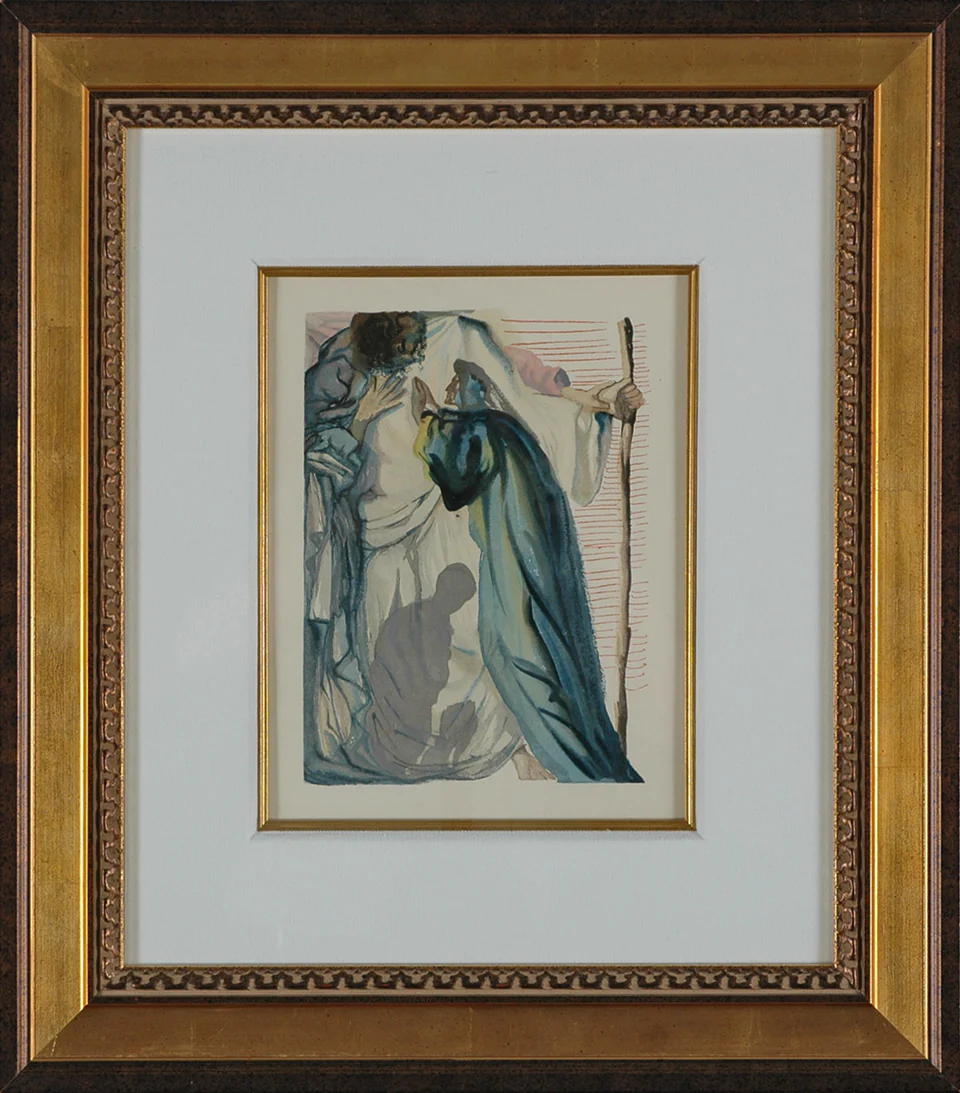
Description of Art: Purgatory Canto 14 unfolds in an atmosphere of somber reflection, and Dalí renders this canto’s meditation on pride and lineage with a quietly immersive, dreamlike gravity. The scene is suffused with muted golds, pale terracotta tones, and cool gray-blue shadows—colors that drift softly across the composition like a fading memory. Light filters through the atmosphere in delicate washes, giving the entire space a sense of suspended stillness.
At the center, a solitary figure emerges with elongated, contemplative posture. Dalí’s fine engraving lines etch the form with clarity, yet the surrounding color dissolves its edges, suggesting a soul caught between recognition and sorrow. This figure becomes the embodiment of the canto’s introspective tone—where the weight of earthly identity begins to lift, revealing the fragility beneath human pride.
Nearby, Dante’s silhouette is humble and receptive. His stance is slightly bowed, as though absorbing the reflections that surround him. Dalí renders him with a grounded presence, the crispness of his contour contrasting with the drifting haze of the environment. Through him, the viewer senses the emotional hush of the moment: a scene where illumination does not shine brightly but dawns gently, through contemplation.
The landscape around them is sparse and surreal—arches dissolving into mist, distant shapes bending like half-remembered architectures, and rocky formations melting into soft shadow. This visual ambiguity reinforces the canto’s theme: the gradual erosion of ego, the unveiling of truth through quiet reckoning.
In this work, Dalí captures the essence of Canto 14: a turning point where identity is examined, pride is stripped away, and the soul begins the ascent toward clarity. The scene glows with restrained emotional depth—a vision where form, light, and silence converge to reveal the first tremors of inner transformation.