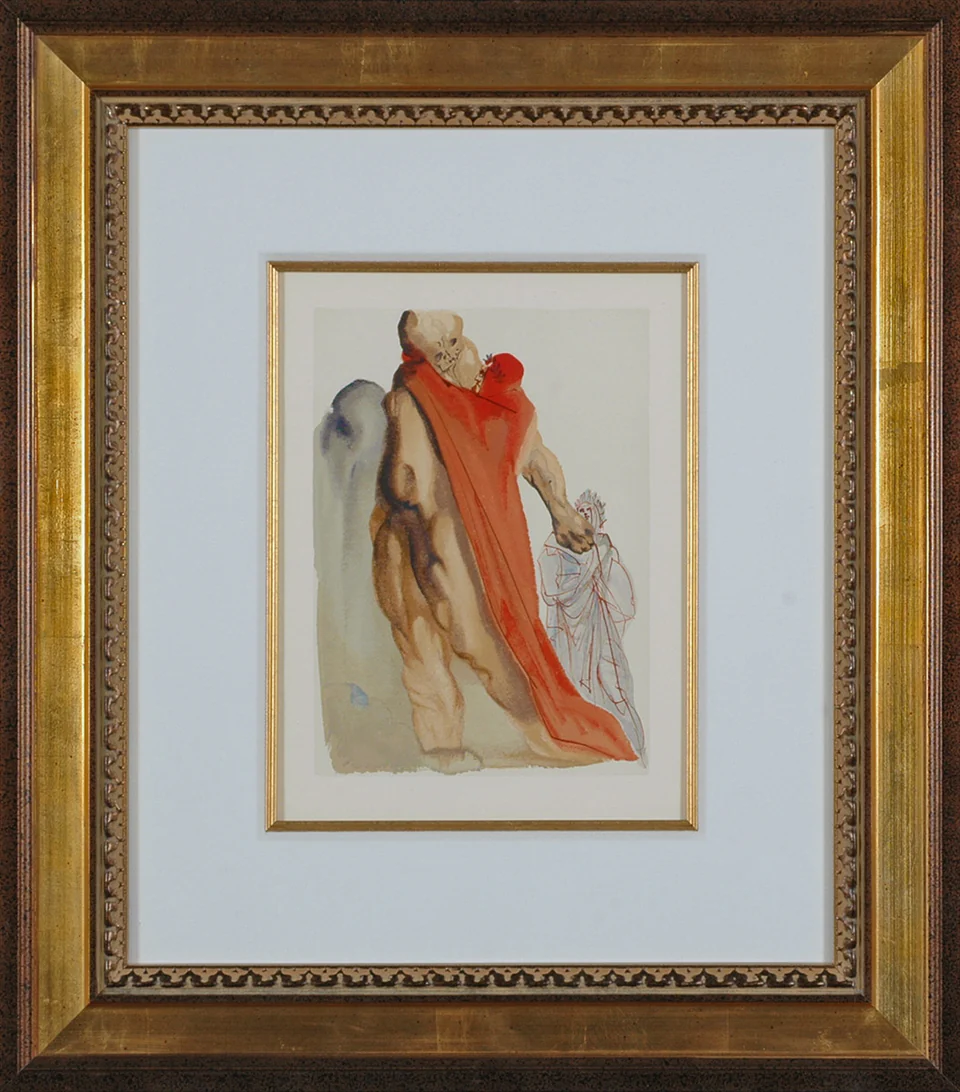
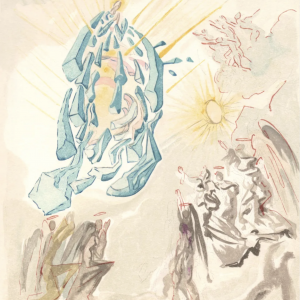
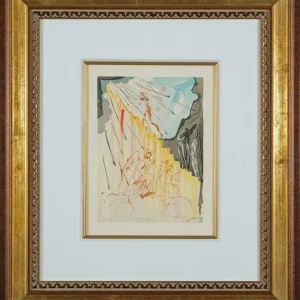
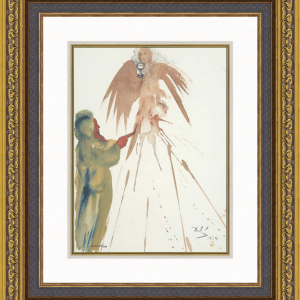
Description of Art: Purgatory Canto 5 presents a critical threshold of the pilgrim’s journey, and Dalí translates this into a vision of reckoning and muted transformation. The composition is filled with gentle, glowing hues of gold, muted rose, and pale aquamarine, which drift across the visual field like an inner light stirring beneath the surface of shadow. The overall atmosphere is one of expectancy, as though the moment captured is less arrival than the instant just before revelation.
At the centre, a procession of elongated figures moves through the terrain—each body outlined with Dalí’s fine engraving lines, then softened into the surrounding light, as if the forms are dissolving into purification. One figure assumes the weight of the scene—a humble, upright form whose posture and bearing suggest the pilgrim himself, conscious yet quietly composed. Dalí draws him slightly apart, his contours steadier, giving the viewer a focal point of human witness amidst the swirling less-defined souls.
The landscape around them is spare but charged with symbolic quiet: faint arches dissolve into mist, pathways tilt toward rising radiance, and the ground beneath loosens into folds of light rather than earth. These elements evoke the canto’s theme of transition—from penitence to hope, from waiting to movement. The framing of space is both internal and external: the terrain seems to reflect the soul’s passage as much as the physical climb.
In this work, Dalí distils the essence of Canto 5: the soul beginning its climb, chastened yet open to the light ahead; a moment when the weight of judgment gives way to the loosening of form, and when the path upward becomes subtly visible. The result is an image of contemplative tension and luminous stillness—where the journey forward is not announced but sensed.