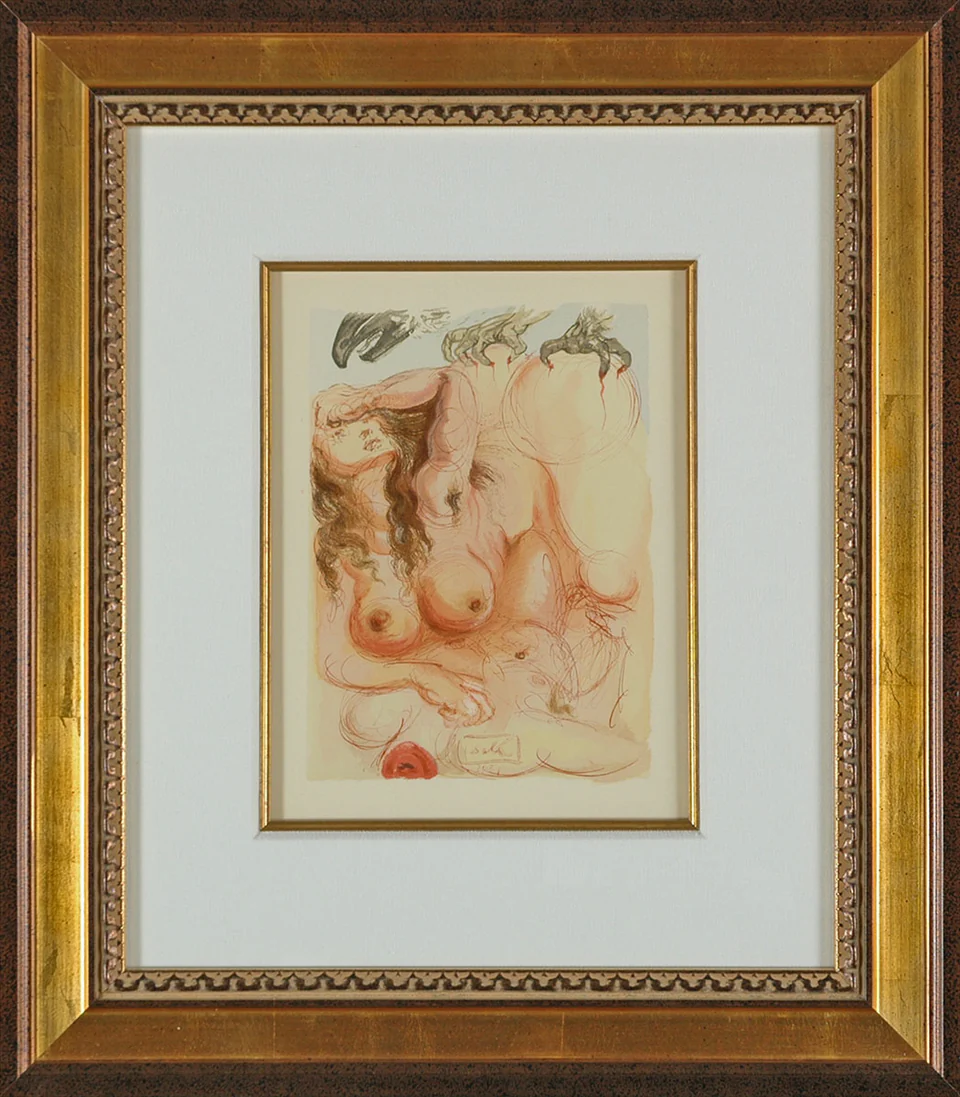
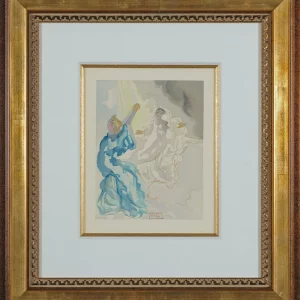
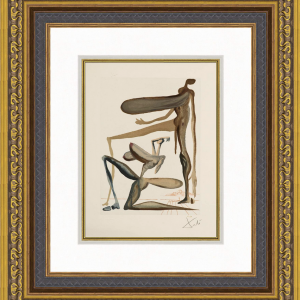
Description of Art: Purgatory Canto 9 captures the moment when the pilgrim crosses into the realm of true purgation, and Dalí transposes this threshold into a vision of luminous transition and inner awakening. The palette glows with pale golds, soft blue-greens, and rose-tinged light—colors that drift like dawn over a terrain of moral reckoning. The light seems to dissolve the air itself, suggesting the boundary between the earthly and the ascending is thinning.
At the centre, elongated figures appear—one kneeling, another standing—caught in the act of threshold-passage. Their outlines are etched by Dalí’s fine engraving lines, while their edges soften into the surrounding haze, marking souls in motion toward cleansing. The central figure of Dante is humble and open-faced, his posture expressive of both trepidation and resolve. Dalí renders him with clarity amid the dissolution of forms around him.
The surrounding landscape is evocative rather than literal: a gateway faintly suggested by arching brilliance, steps that seem to ascend though un-carved, and mist-inflected planes of color that ripple outward from the figures. These elements echo the canto’s imagery of the three symbolic steps and the angel’s sword-point marking the poet’s forehead.
Here, Dalí distills the essence of Canto 9: the entry into purgation, the recognition of sin and hope, and the soul poised on the brink of transformation. The scene shines not with triumph, but with a quiet, charged stillness—where the journey continues, and light begins its work of unveiling.