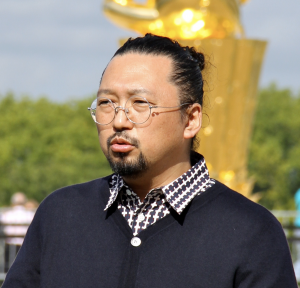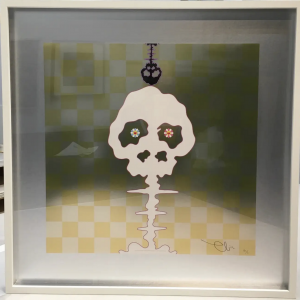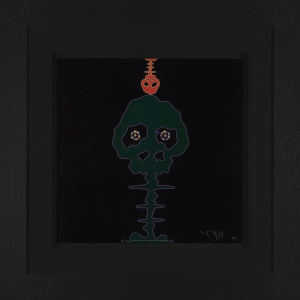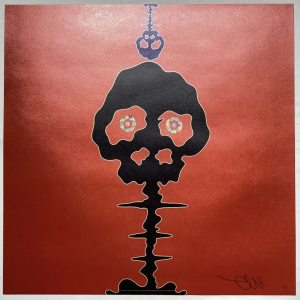
Takashi Murakami is a Japanese contemporary artist whose work has reshaped global perceptions of the relationship between fine art, popular culture, and commerce. Born in Tokyo, Murakami studied traditional Japanese painting (nihonga) at the Tokyo University of the Arts, earning both his MFA and PhD. This rigorous academic training provided the foundation for his later critical engagement with Japan’s postwar visual culture.
Murakami is best known as the founder of the Superflat movement, a concept he developed to describe both the flattened visual style of Japanese graphic culture and the collapse of boundaries between high art and mass production. His paintings and sculptures—featuring smiling flowers, anime-inspired characters, and recurring figures such as Mr. DOB—combine bright color, meticulous execution, and sharp cultural commentary.
In addition to his studio practice, Murakami established Kaikai Kiki Co., a production studio and artist incubator that challenges traditional notions of authorship and art-making. His work has been exhibited at major institutions worldwide, including the Museum of Modern Art (New York), the Palace of Versailles, and the Broad Museum (Los Angeles), and he has collaborated extensively with fashion, music, and luxury brands.
Through his synthesis of traditional Japanese aesthetics, contemporary consumer culture, and conceptual rigor, Takashi Murakami has become one of the most influential artists of the 21st century, redefining how art circulates between the museum, the marketplace, and popular imagination.