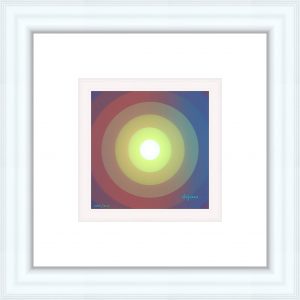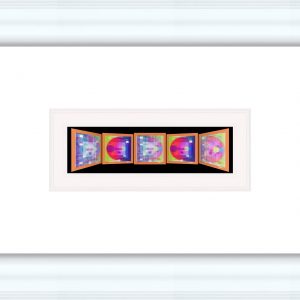
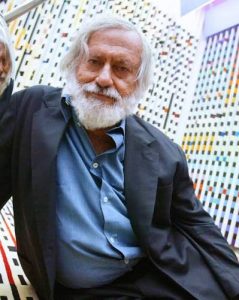
Yaacov Agam (1928–2026) was an internationally celebrated Israeli artist, sculptor, and visionary widely regarded as the father of the Kinetic Art movement. Through a career spanning more than seven decades, Agam revolutionized the relationship between artwork and viewer by introducing movement, time, and participation as essential elements of artistic experience. Rejecting the notion of art as a static object, he pioneered dynamic works that continually transform according to the viewer’s position, fundamentally reshaping the language of modern and contemporary art.
Born Yaakov Gipstein on May 11, 1928, in Rishon LeZion, Israel, Agam was raised in a deeply spiritual household as the son of Rabbi Yehoshua Gibstein, a respected Kabbalist. This early exposure to Jewish mysticism profoundly influenced his artistic philosophy, inspiring his lifelong exploration of movement, infinity, and the ever-changing nature of reality. He studied at the Bezalel Academy of Arts and Design in Jerusalem before continuing his education in Zurich under renowned Bauhaus masters Johannes Itten and Max Bill, whose teachings in color theory, geometry, and design became foundational to his artistic development. In 1951, Agam settled in Paris, where he established his international career and held his first solo exhibition in 1953.
Throughout his career, Agam worked across painting, sculpture, environmental design, architecture, printmaking, and public art, consistently challenging conventional perceptions of space and time. He developed the groundbreaking Agamograph, a lenticular technique that allows multiple images to emerge as viewers move around the artwork. His kinetic reliefs, transformable sculptures, and monumental public installations invite active participation, emphasizing that no single viewpoint can fully define a work of art. For Agam, change itself was the essence of existence, and each encounter with an artwork became a unique and unrepeatable experience.
Agam’s work has been exhibited in many of the world’s most prestigious museums and is represented in the permanent collections of institutions including the Museum of Modern Art (MoMA) in New York, the Solomon R. Guggenheim Museum, the Hirshhorn Museum and Sculpture Garden, the Centre Pompidou, and museums throughout Europe, Asia, and Israel. His public commissions—including the celebrated Fire and Water Fountain in Tel Aviv, the Elysée Salon at the Centre Pompidou, and monumental installations in New York, Paris, Jerusalem, and Taiwan—have become enduring landmarks of modern public art.
Among his many honors, Agam received the Chevalier and later Commandeur de l’Ordre des Arts et des Lettres from the French government, the UNESCO Jan Amos Comenius Medal, the Sandberg Prize from the Israel Museum, and the 2026 Israel Prize for Visual Arts, the nation’s highest cultural distinction. His legacy was further cemented with the opening of the Yaacov Agam Museum of Art in Rishon LeZion, dedicated exclusively to preserving and celebrating his life’s work.
Today, Yaacov Agam is recognized as one of the most influential artists of the twentieth and twenty-first centuries. His groundbreaking innovations transformed the possibilities of abstraction, kinetic art, and viewer participation, inspiring generations of artists to think beyond the fixed image. Through works that continually evolve with movement and perspective, Agam demonstrated that art is not a static object but a living experience—one that reflects the perpetual transformation of life itself.
Showing all 2 results